Pasteurised vs Unpasteurised Kombucha: What's the Difference?
Pasteurised vs Unpasteurised Kombucha: What's the Difference?
Walk into a supermarket, and you'll find kombucha sitting on a warm ambient shelf. Visit a specialist producer like Monty Booch, and you'll find it refrigerated, with a shorter shelf life and visible cloudiness in the bottle. These aren't just different brands; they're fundamentally different products.
The difference comes down to one process: pasteurisation. Understanding what it does and what it takes away is the key to knowing what you're actually buying.
What Is Pasteurisation?
Pasteurisation is a heat treatment process developed by Louis Pasteur in the 19th century. It involves heating a liquid to a specific temperature for a set period of time to kill harmful bacteria and extend shelf life. It's used widely across the food and drink industry milk, juice, beer, and increasingly, kombucha.
For kombucha, pasteurisation typically involves heating the finished brew to around 82°C for at least 30 seconds. This kills any harmful pathogens present in the drink but it also kills something else.
What Pasteurisation Does to Kombucha
Kombucha is a living drink. It's produced through fermentation a process where a SCOBY (Symbiotic Culture of Bacteria and Yeast) works through sweetened tea over several days, producing organic acids, natural carbonation, and live cultures. That living quality is the point of kombucha.
When you heat kombucha to pasteurisation temperatures, those live cultures are destroyed. Research published in ScienceDirect notes that pasteurisation results in a high level of non-living microorganisms in commercial kombucha, meaning what you're drinking is technically a postbiotic rather than a probiotic drink. The distinction matters: a probiotic delivers live cultures to your gut; a postbiotic delivers the by-products of fermentation, but without the living organisms themselves.
Beyond the cultures, pasteurisation also affects:
Flavour. The heat treatment dulls the natural complexity of raw kombucha, the sharpness, the layered tartness, the subtle effervescence that develops through live fermentation. Pasteurised kombucha tends to taste flatter and more one-dimensional than its raw counterpart.
Carbonation. Natural carbonation in raw kombucha is produced by active fermentation. Pasteurisation halts this process, so carbonation in pasteurised kombucha is often added artificially after processing, producing larger, coarser bubbles rather than the fine natural effervescence of a live brew.
Nutritional profile. Heat treatment can degrade heat-sensitive nutrients, including vitamin C and certain antioxidants naturally present in kombucha from the tea base.
Why Do Some Producers Pasteurise?
It's worth being fair here: pasteurisation exists for good reasons, and producers who use it aren't cutting corners carelessly.
Shelf stability. Pasteurised kombucha can be stored at room temperature for months, which makes it far easier to distribute through supermarkets and large retail chains. Raw kombucha requires a cold chain from brewery to consumer — which is more complex and expensive to manage.
Consistency. Live fermentation is unpredictable. Active cultures continue to develop flavour even after bottling, which means raw kombucha can taste slightly different batch to batch. Pasteurisation locks the flavour profile at a fixed point.
Safety at scale. For very large volume producers, pasteurisation provides a reliable safety net against contamination. At small batch scale, the natural acidity of properly fermented kombucha — typically pH 2.5 to 3.5 — creates an environment hostile to harmful pathogens without the need for heat treatment.
These are legitimate commercial considerations. But they serve the producer's convenience more than the consumer's benefit.
The Case for Unpasteurised Kombucha
Raw, unpasteurised kombucha is the original product — the way kombucha has been made for over 2,000 years before large-scale commercial production required extended shelf life.
Live cultures intact. The gut health benefits of kombucha come primarily from its live cultures and organic acids. In unpasteurised kombucha, these survive the journey from brewery to glass. The SCOBY culture that produced them is still active in every bottle — which is why raw kombucha looks slightly cloudy. That cloudiness is the live culture. It's a feature, not a flaw.
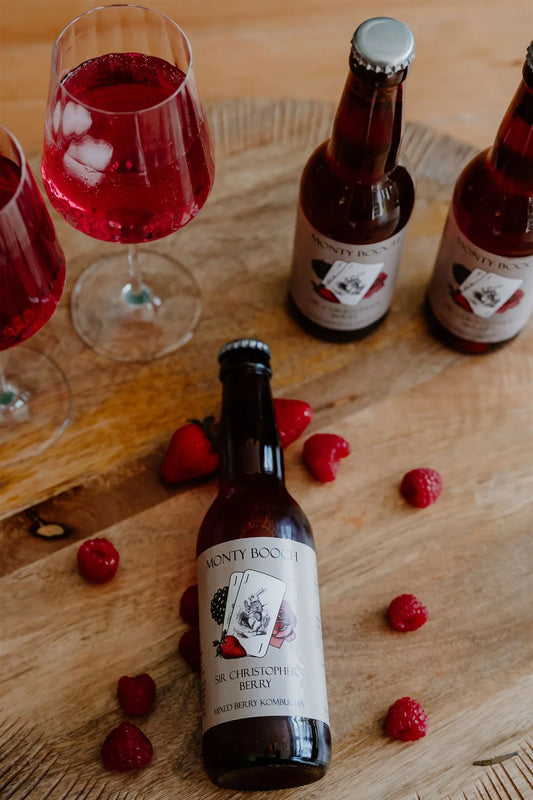
Genuine flavour complexity. Raw kombucha tastes the way fermented food should — layered, nuanced, slightly different each batch. The fine natural carbonation, the depth of the organic acids, the way the fruit flavours interact with the ferment base — none of this survives pasteurisation intact. The Great Taste Award judges who gave Monty Booch's Sir Christopher Berry 2 Stars specifically praised its "depth of fermentation" and "fine bubbles" — qualities that are only possible in an unpasteurised product.
No need for preservatives. Because raw kombucha's natural acidity inhibits harmful bacterial growth, it doesn't require preservatives to remain safe. Some pasteurised kombucha producers add sodium benzoate or potassium sorbate after heat treatment to prevent re-fermentation — additives you won't find in a properly brewed raw kombucha.
Authentic fermentation credentials. If you're drinking kombucha for its gut health benefits, the distinction between a live probiotic drink and a heat-treated postbiotic matters. When and how you drink kombucha also affects how well your body receives those benefits — but it starts with choosing a product that has them in the first place.
How to Tell the Difference
The easiest way to tell whether a kombucha has been pasteurised:
Check where it's stored. Raw, unpasteurised kombucha must be refrigerated. If it's sitting on an ambient shelf, it has been pasteurised or heavily preserved. No exceptions.
Look for cloudiness. A raw kombucha will often have visible sediment or cloudiness from the live culture. A clear, bright kombucha that has been sitting at room temperature is a pasteurised product.
Read the label. Look for "raw," "unpasteurised," or "live cultures" on the label. Pasteurised products rarely advertise the fact — but the absence of "raw" or "unpasteurised" on a shelf-stable product tells you what you need to know.
Check the shelf life. Raw kombucha has a shorter best-before date — typically a few months from bottling. A kombucha with a shelf life of 12 months or more has almost certainly been pasteurised.
Is Pasteurised Kombucha Worth Drinking?
Honestly, it depends on what you're drinking it for.
If you're looking for a lightly fizzy, mildly tangy soft drink alternative and gut health benefits aren't your primary motivation, pasteurised kombucha is a perfectly reasonable choice. It's widely available, shelf-stable, and safe for most people, including those who are pregnant or immunocompromised groups who are sometimes advised to avoid raw fermented products.
If you're drinking kombucha specifically for its live cultures, its probiotic properties, and the full complexity of flavour that genuine fermentation produces, unpasteurised is the only version that delivers that. The trace alcohol content, the natural carbonation, the cloudiness, and the shorter shelf life are all signs of a living, properly fermented product. They're not inconveniences to be engineered away.
Monty Booch: Always Raw, Always Unpasteurised
Every bottle of Monty Booch is brewed in small batches near Buckingham, bottled with its live cultures intact, and never heat-treated. We don't pasteurise, we don't filter, and we don't add preservatives. The cloudiness in the bottle is the SCOBY culture that brewed it. The short shelf life is a sign it's alive.
Our Sir Christopher Berry was awarded 2 Stars at the Great Taste Awards 2025 — blind judged, no brand bias, purely on taste and quality. That kind of result doesn't come from a pasteurised product.
If you're ready to try raw, unpasteurised kombucha the way it should be made, our Mixed Case is the perfect place to start — three distinct flavours, free UK shipping on orders over £50.
Any questions? Drop us a line at hello@montybooch.co.uk